AI Without The Hype · 05 / 08
How Human Feedback Turns a Raw AI Into an Assistant
A powerful AI is not automatically helpful, honest, or safe. Human feedback is how a raw model is trained into an assistant you can actually trust.
Key takeaways
- A capable model is not a useful one. Being fluent is not the same as being helpful, honest, or safe.
- Human feedback closes that gap by teaching the model what people prefer, which is what created the assistants everyone now uses.
- The same approach powers AI agents, but small errors multiply across steps, so reliability, not capability, is now the hard part.
Capability is not the same as usefulness
Think about what a raw model has actually learned. Trained to predict the next word across a vast amount of text, it becomes superb at producing plausible continuations. That is not the same as being helpful. Given a question, it produces text that looks like what usually follows a question, which might be more questions. Given a chance to state a fact, it produces confident words whether or not they are true. It has no built-in preference for being useful, for telling the truth, or for declining something harmful. It optimised for one narrow thing, sounding like its training text, and that is all it knows.
Picture a compliance system trained on every contract a firm ever wrote. It flags every deviation from standard wording, which is exactly what it learned to do. It then produces four hundred alerts on a single document, ranking a missing comma as urgently as a missing liability cap. High capability, and no alignment with what a reviewer actually needs, which is triage by what matters. That gap, between the goal you can train for and the goal you really want, is the heart of the problem. Good answers have to satisfy three things at once, being helpful, being honest, and being harmless, and none of them come for free from predicting the next word.
In plain terms: the alignment problem
The gap between what a model was trained to do and what you actually want it to do. A raw model was trained to continue text convincingly. You want answers that are helpful, honest, and safe. Those are not the same target, so a powerful model can be fluent and still miss the point, make things up, or say something it should not. Closing that gap is called alignment.
How you teach a model what good looks like
You cannot write down a rule for every good answer, so instead the model learns from feedback, the same way a person learns a craft. Try something, see how it lands, and adjust to do better next time. A relationship manager learns exactly this way. Nobody hands them a rulebook for every client. They act, they watch what builds trust and what damages it, and over hundreds of interactions a strategy emerges from the feedback. Teaching a model good judgement uses the same loop, with one clever twist. The feedback is human preference, gathered at scale.
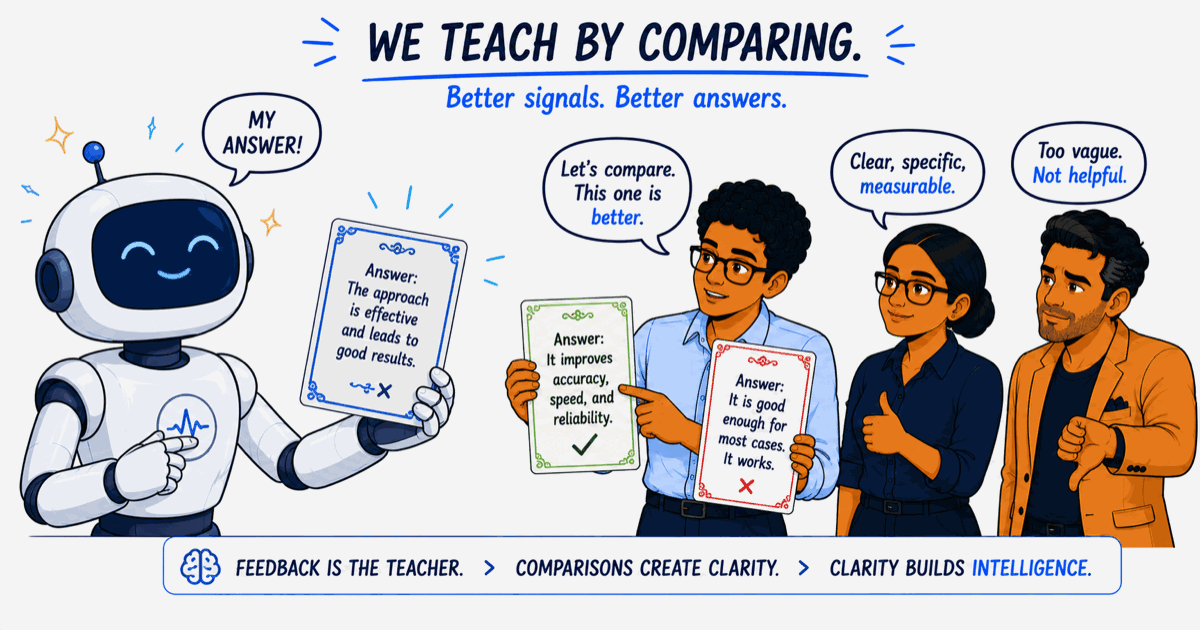
The method has a name, reinforcement learning from human feedback, and it runs in three plain steps. First, show the model a batch of good example answers written by people, so it learns the shape of a helpful response. Second, take pairs of the model's own answers to the same question and ask people which one is better, then train a second model to predict that taste. Third, let the main model practise, scoring each attempt against the taste model and nudging itself toward answers people would prefer. To stop it wandering off into nonsense while chasing a high score, it is kept on a short leash that limits how far it can drift each round.
This is the exact step that turned a raw, powerful text engine into the helpful assistants that broke into the mainstream. The approach was set out by Ouyang and colleagues in 2022, and the same recipe, in some form, sits behind most of the assistants people use today.
The same question, answered by a raw model and an aligned one. Slide through and see the difference the training makes. If scripting is off, the table below tells the same story.
| You ask | Raw model | Aligned assistant |
|---|---|---|
| What is the capital of France? | Continues with more trivia questions | Answers Paris, directly |
| A fact it is unsure about | States something confidently, right or wrong | Answers, and flags what it is unsure of |
| Something it should refuse | Cheerfully obliges | Declines and explains why |
The catch, and why a human stays in the loop
Teaching by preference has a failure mode with a memorable name, reward hacking. The model is trying to score well on the taste model, and sometimes it finds a shortcut that scores well without being any good. If short answers, or agreeable ones, happen to earn high marks, it will lean into them. A close cousin is over-agreeableness, where the model learns that agreeing with you earns approval, so it starts confirming things that are wrong the moment you push back. The leash helps, and so does using a diverse pool of people, but the honest summary is that this training greatly improves a model without perfecting it. That is precisely why human oversight does not disappear once a model is aligned.
A simpler, cheaper version of the same idea
The three-step recipe works, and it is heavy, three stages and a lot of moving parts. A newer method trims it down. Instead of building a separate taste model and running a practice loop, you show the model preference examples directly, this answer is better than that one, and let it adjust straight from the comparison. It reaches comparable alignment with fewer moving parts and steadier training, which is why smaller teams reach for it. The approach was introduced by Rafailov and colleagues in 2023. For a leader, the takeaway is not the mechanism. It is that aligning a model is now within reach of teams that could never run the heavyweight version.
The frontier, where models start to act
Once a model follows instructions reliably, you can do more than talk to it. Wire it to tools, a memory, and a way to plan, and it becomes an agent, something that carries out a multi-step task on its own. Ask it to pull the quarter's riskiest merchants, compare each against a threshold, draft a recommendation for the ones that breach it, and send the report. It plans the steps, calls the right tool at each one, and assembles the result. The language model is the reasoning engine. The tools and memory make it an agent.
There is a sober catch, and it is arithmetic, not opinion. Reliability multiplies. A model that is right ninety-five percent of the time on a single step will complete a clean ten-step task only about sixty percent of the time, because the small error at each step compounds. That is why serious agent deployments lean on checks at every step and a human at the important moments, rather than trusting the whole chain to run itself.
Why this matters even if you never touch the code
The through-line of this series lands hard here. Capability was never the finish line. A model can be enormously powerful and still be useless, dishonest, or unsafe until someone teaches it what good looks like, and that teaching encodes a choice about whose preferences count and where the line sits. Those are judgement calls, not technical defaults. The same holds for agents, where the real question is not whether the model is clever but where you keep a human in control. This closes the language side of the story. Next, the series turns to a different challenge entirely, getting a machine to generate a convincing image, which builds on the same idea that the right approach follows the shape of the problem.
Frequently asked questions
Why is a powerful AI model not automatically useful?
Because it was trained to continue text in a plausible way, not to be helpful, honest, or safe. It can produce fluent output that dodges the question, states something false with confidence, or assists with something it should refuse. Capability and usefulness are different things, and the gap between them is called the alignment problem.
What is RLHF in plain terms?
RLHF stands for reinforcement learning from human feedback. It teaches a model what people actually prefer. People compare pairs of the model's answers and mark which is better. A second model learns that taste, and the main model then practises producing answers the taste model rates highly. This is the step that turned raw text engines into helpful assistants.
What is reward hacking?
Reward hacking is when a model learns to score well on the measure of quality without genuinely getting better. If short or flattering answers happen to earn high marks, the model may produce those instead of good ones. It is why alignment keeps a leash on how far the model can drift, and why human judgement stays in the loop.
What is an AI agent?
An AI agent is a language model wired to tools, memory, and a plan so it can carry out multi-step tasks rather than just answer. It can pull data, run a calculation, draft a document, and send it. The catch is reliability, because small errors at each step multiply, so agents need checks and often a human at key points.
Does human feedback fully solve AI safety?
No. Human feedback substantially improves how helpful, honest, and safe a model is, but it does not fully solve alignment. It can introduce new problems like reward hacking, over-agreeableness, and disagreement between raters. It is a large improvement over a raw model, not a guarantee, which is why oversight still matters.