AI Without The Hype · 02 / 08
Why the Best AI Model Depends on the Shape of Your Data
Making an AI deeper adds power and fresh ways to fail. The winning move is not one giant model, it is matching the model to the shape of your data.
Key takeaways
- Making a model deeper adds real power and a brand new way to break, so depth is a trade, not a free upgrade.
- Pictures and sequences are different shapes of information, and each needs a different kind of model.
- You almost never build from scratch. Teams adapt a model someone else already trained, turning weeks of work into hours.
Making an AI deeper makes it smarter and more fragile at the same time
The headline advance in modern AI is depth. Instead of one big layer of calculation, these systems stack many layers, one after another. It matters because each layer gets to build on the one before it. Early layers spot the simplest things. In an image, that is an edge or a patch of colour. In a sentence, it is a single word. The next layer combines those into something richer, edges into shapes, words into phrases. By the top, the model is working with objects and meaning. A shallow model has to grasp all of that in one go, with no structure to lean on. Depth is what lets a model learn in sensible steps rather than all at once.
Depth also brings a problem that is not obvious until it bites. The way these models learn is by pushing a correction backwards through every layer, from the answer at the top down to the very first layer. The trouble is that the correction gets a little weaker at each step it passes through. Stack enough layers and, by the time it reaches the bottom, there is almost nothing left. The earliest layers stop learning entirely. It is the quiet reason very deep models were hard to train for years.
In plain terms: the fading signal
Think of a clear instruction shouted at the top of a bank, then passed down through twelve layers of the hierarchy. At each handover it gets summarised and softened. By the bottom it has gone from "reverse transaction 4521 now" to "some customer had a concern." The instruction that started sharp arrives as noise. The learning signal inside a deep model fades the same way, which is why the early layers can stall.
Engineers did not give up on depth. They invented fixes for the fading signal, including a now-standard trick of adding shortcut paths that let the signal skip past layers instead of being watered down through every one. That single idea let a landmark image model called ResNet train networks over a hundred and fifty layers deep and win at image recognition, a result published by Kaiming He and colleagues in their 2015 paper. The lesson for a non-specialist is the useful part. Depth is powerful, and it needs deliberate engineering to work. It is not a dial you can simply turn up.
There is no single AI shape that fits every problem
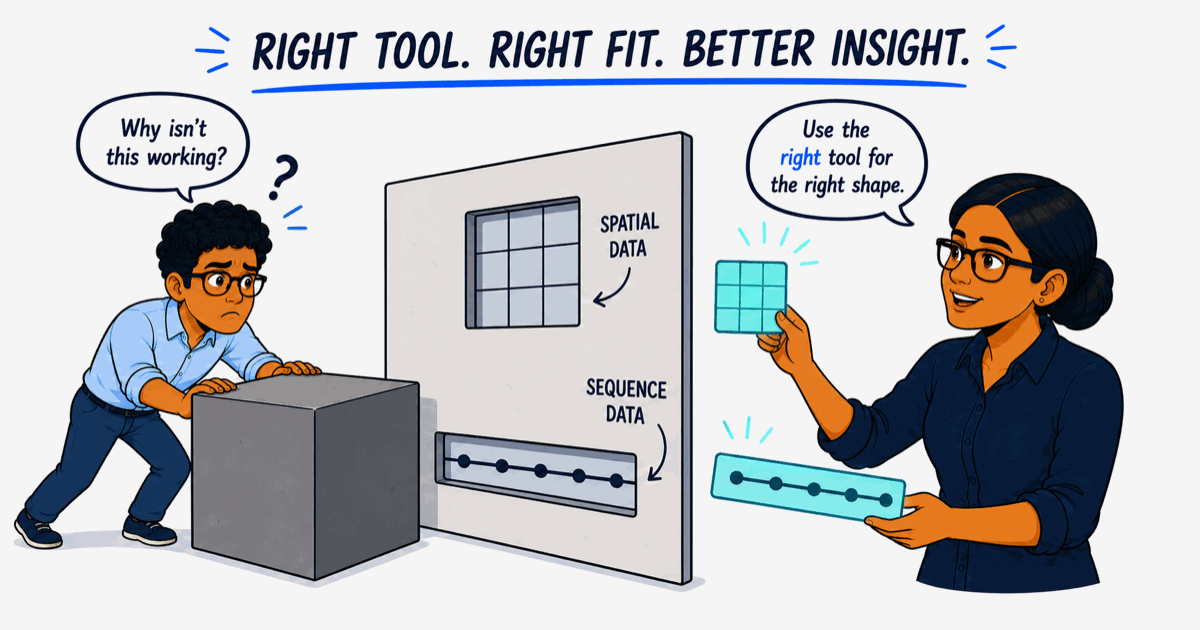
Here is the idea that makes sense of every model choice you will ever hear argued about. The shape of your problem decides the shape of the model, not the other way round. A picture is a grid where nearby parts belong together, so the right model sweeps a small pattern detector across the whole image and reuses it everywhere. A sentence or a stream of transactions is an ordered sequence, where what came first changes the meaning of what comes next, so the right model reads in order and carries a running memory of what it has seen. Feed a picture to the sequence model, or a sentence to the picture model, and results fall apart, because each is built for a different shape of information. This is why there is no single best AI. There is only the model that matches the structure of the thing you are trying to understand.
When the data is a picture, the model slides a magnifying glass over it
For anything laid out in space, a photo, a scanned form, an X-ray, the winning design is a model that slides one small pattern detector across the whole image, step by step. At each spot it asks a simple question, is my pattern here or not, and builds a map of the answers. The clever part is that the same detector is reused at every position. An edge detector that works in the top-left corner works just as well in the bottom-right, so there is no reason to learn a separate one for every location. That reuse is why this design is dramatically more efficient than a model that treats every pixel as its own separate input.
This is not abstract. A payments team building a document tampering detector does not train a vision model from scratch. They take a model already trained on a giant public image collection of roughly 1.2 million pictures across a thousand everyday categories, keep the general visual skills it already has, and retrain only the final part to spot authentic versus altered documents. The general features, edges and textures and shapes, carry straight over. Training time drops from weeks to hours. The public collection they usually start from, ImageNet, is the same one much of modern computer vision was built on.
In plain terms: transfer learning
Reusing a model that has already learned general skills, then retraining only the last piece for your specific task. It is the difference between hiring someone who already reads and writes and teaching them your forms, versus teaching a newborn to read first. It is why serious computer vision no longer needs a giant budget or a research lab.
When the data is a sequence, the model needs a memory
Language and time do not sit still in a grid. They run in order, and order carries meaning. "The dog bit the man" and "The man bit the dog" use the same words and mean opposite things. A transaction stream is the same. A small purchase after a declined card on a new device reads very differently from the same purchase on its own. To handle this, the model reads one item at a time and keeps a running memory, a summary of everything it has seen so far, which it updates at each step.
The plain version of this memory model has a weakness. By the end of a long sequence it has mostly forgotten the start, because everything has been squeezed into one small summary that keeps getting overwritten. The fix was a smarter memory with three simple controls, which is easiest to picture as a credit officer keeping a running file on a borrower.
Tell it the shape of your data and see which kind of model fits. If scripting is off, the table below tells the same story.
| Your data looks like | Everyday example | The model that fits |
|---|---|---|
| A grid laid out in space | Photos, scanned IDs, X-rays | Pattern-slider model |
| A sequence in order | Sentences, transaction streams | Running-memory model |
| A very long sequence where start and end both matter | Full contracts, long histories | Attention model, the next chapter |
In plain terms: the gated memory
A credit officer keeps a running file on a borrower. A forget control drops what no longer matters, a stale address, a one-off late payment from years ago. An input control writes in what is newly important, a fresh salary, a large recent purchase. An output control decides which parts of the file to actually use for today's decision. The smarter memory model works exactly like this, which is how it holds on to what matters across a long sequence instead of letting it wash away.
The limit that sets up the next breakthrough
Even the smarter memory has two limits worth knowing, because they explain what comes next. First, across very long stretches, thousands of steps, it still forgets. The memory attenuates. Second, and this is the one that decided the whole field, it must read one step at a time. Step two cannot start until step one is done. On modern hardware that is slow, because the work cannot be spread out and done in parallel.
Both limits fall to a single newer design. Instead of shuffling a memory along the sequence one step at a time, it connects any two points in the sequence directly and weighs how much each one matters to the others, all in one pass. Nothing has to travel step by step, so nothing fades with distance, and the whole thing can be computed at once rather than in a slow chain. That design, introduced in 2017 in a paper titled Attention Is All You Need, is the transformer. It is the foundation under nearly every large language system in use today, and it is where this series goes next.
Why this matters even if you never touch the code
You do not need to build any of this to make sharper calls with it. The one question that cuts through most AI debates is not "which model is best." It is "what shape is my problem." A grid of pixels, an ordered stream, a very long document where the beginning and the end both matter, each points at a different kind of model, and reaching for the wrong shape is how good teams waste months. The related idea, that you adapt an existing model rather than build from scratch, is what turns an intimidating project into a practical one.
This connects straight back to the quieter point from the first piece in this series. The biggest model on the market does not choose wisely on its own, and neither does the newest architecture. Someone still has to match the tool to the job. That judgement is the real work, and it stays with you, not with the tool.
Frequently asked questions
Is there one AI model that is best at everything?
No. The shape of the problem decides the shape of the model. Pictures need a model that sweeps a small pattern detector across a grid. Sentences and transaction streams need a model that reads in order and keeps a running memory. Feed one to the wrong kind and results collapse, because each is built for a different shape of information.
Why does making an AI deeper make it more powerful?
Depth lets a model build understanding in steps. Early layers spot simple things like edges or single words. Later layers combine those into shapes, objects, and meaning. A shallow model has to learn all of that at once with no structure, so a deep model learns richer patterns from the same data.
What is the vanishing gradient problem in plain terms?
It is the learning signal fading before it reaches the earliest layers of a deep model. The correction that teaches the model gets a little weaker at each layer it passes back through. Stack too many layers and it arrives as near-zero noise, so the early layers stop learning. It is why very deep models needed new tricks to train at all.
Do businesses have to train these models from scratch?
Rarely. Most teams take a model already trained on millions of general examples, freeze the parts that learned broad features, and retrain only the final part on their own smaller dataset. This is called transfer learning, and it cuts a job that would take weeks of computing down to hours.
What replaced these models for language tasks?
The transformer, introduced in 2017. The earlier running-memory model reads one step at a time and still forgets across very long stretches. The transformer connects any two points in a sequence directly and processes them together, which removed both limits and now powers most large language systems.