AI Without The Hype · 04 / 08
How the Same AI Engine Becomes Two Different Machines
The same AI engine trained two ways becomes an understander or a generator. Adapting either into a specialist is cheap, and that turns power into a product.
Key takeaways
- Understanding and generating are the same engine trained on two different jobs, so the training objective decides the capability.
- A powerful model is not yet a useful product. Instruction tuning is the step that teaches it to follow a request instead of just continuing text.
- Adapting a giant model to your task is now cheap. A small add-on trained on a fraction of the parts reaches close to full performance.
One engine, two jobs, two very different machines
Start with the engine from the previous chapter, the design that lets every word weigh every other word. Now train it two different ways. In the first, you blank out some words in ordinary text and ask the model to fill them back in, using the words on both sides as clues. To do that well it has to genuinely understand how a sentence hangs together. The result is a machine that is excellent at reading a fixed piece of text and making sense of it. It sorts complaints, extracts a merchant name and amount from a messy description, and powers search that understands meaning rather than matching keywords.
In the second, you never let the model peek ahead. You show it text left to right and ask only one thing at every step, what is the next word. Do that across billions of words and it becomes fluent at continuing anything you give it. This is a generator. It writes, drafts, summarises, and answers. The two machines share an architecture and almost nothing else, because what a model can do is set by the job it was trained on, not by some difference in its wiring.
In plain terms: the training objective
The single job a model is drilled on, millions of times, while it learns. Fill in the blank using both sides of the sentence, and it grows into an understander. Guess the next word using only what came before, and it grows into a generator. Same engine, same raw material, different drill. The objective is the fork in the road that decides what the finished model is good at.
Pick a task and see which machine fits it. If scripting is off, the table below tells the same story.
| What you need done | The machine that fits | Why |
|---|---|---|
| Sort complaints into billing versus fraud | Understander | Reads a fixed input and judges it |
| Pull the merchant and amount from a messy note | Understander | Labels each part of a given text |
| Draft a reply to the customer | Generator | Produces new text from a prompt |
| Summarise a long report | Generator | Writes something that was not in the source |
A powerful model is not yet a useful product
Here is a fact that surprises people. Straight out of training, a powerful generator is strangely hard to use. Ask a raw one "what is the capital of France" and it might reply with more questions in the same style, "what is the capital of Germany, what is the capital of Spain", because it learned to continue text, not to treat your words as a request to act on. It has the knowledge. It has not been taught the job of following instructions.
The fix is a light second round of training called instruction tuning. You show the model thousands of examples in the shape of an instruction followed by a good response, and it learns the pattern, this is a request, produce a direct and useful answer. It is the difference between passing a language exam and passing a real client brief. One proves you know the words. The other proves you can take an instruction, understand what is wanted, and deliver it. Instruction tuning is the quiet step that turns a raw text engine into something that behaves like an assistant.
You almost never rebuild the engine, you adapt it
Once a base model exists, most of the real work is adaptation, and this is where cost used to be brutal. Fine-tuning means taking a model that already knows language in general and nudging it toward your specific task with a small labelled set. Think of onboarding an experienced consultant to a new client. Nobody rebuilds their core skills. They pick up the client's jargon, the key people, the house style. The broad ability is already there, so a few hundred to a few thousand examples can go a long way.
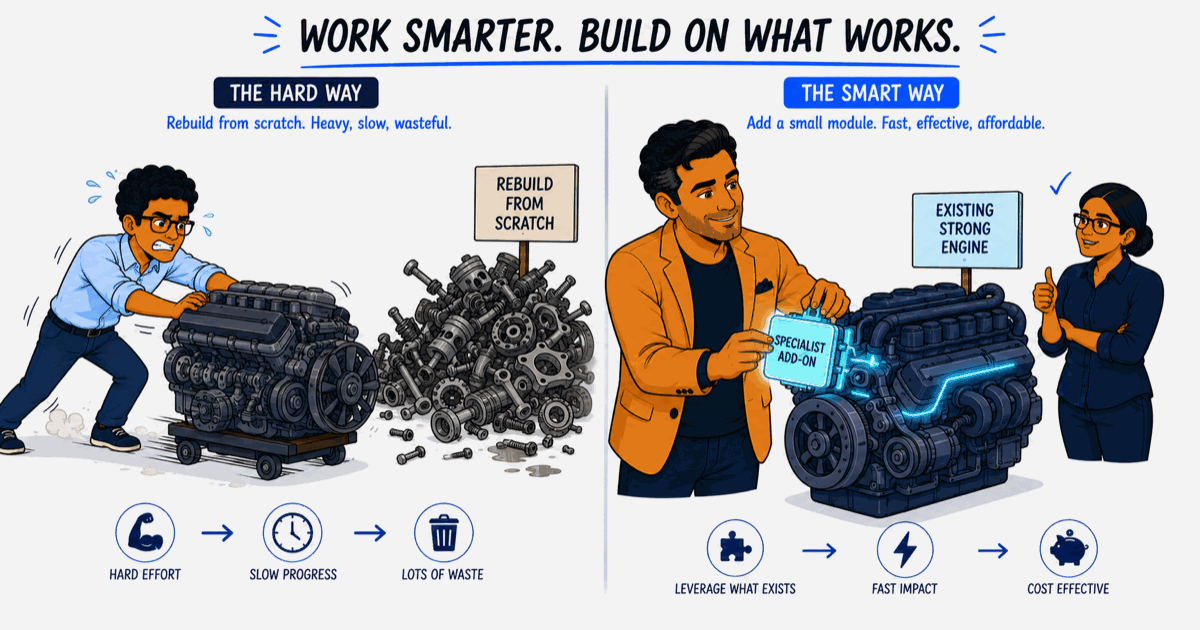
The problem is size. A large model can carry hundreds of billions of adjustable parts, and fully retraining all of them takes hundreds of specialised chips and weeks of time. Almost no one can afford that per task. The breakthrough that fixed it is called LoRA. Instead of retraining the whole model, you freeze it and train a small add-on that captures just the adjustment your task needs. That add-on is often a tenth of a percent to one percent of the model, yet it reaches close to full performance. The approach was introduced by Hu and colleagues in 2021, and it is a large part of why customising a big model went from a data-centre project to something a small team can do.
In plain terms: LoRA
A way to teach a giant model a new speciality without retraining it. You lock the original in place and train a small add-on that sits alongside it, carrying only the change your task requires. Because the add-on is a tiny fraction of the whole, it is fast and cheap to train, and several different add-ons can be swapped onto the same base model for different jobs.
The catch, and why gentle wins
Adaptation has a failure mode worth naming, because it explains a lot of quietly broken models. Push the training too hard and the model forgets what it used to know. This failure mode is catastrophic forgetting. Picture a fraud model retrained hard on a new wave of online scams. It gets sharp on the new patterns and, in the process, overwrites the settings that once caught the older in-person ones. When the old patterns come back, it misses them. The lesson is that adaptation should be a nudge, not a demolition. A gentle touch, or a frozen base with a small add-on, keeps the hard-won general knowledge intact while still learning the new task.
Why this matters even if you never touch the code
The through-line is simple and useful. Capability comes from how a model is trained and adapted, not from raw size alone. The same engine can be an understander or a generator. A powerful base model is not a product until someone tunes it to follow instructions and adapts it, carefully, to the actual job. Those are decisions, and they are where value is won or lost. This also sets up the next question in the series. Even an instruction-following model is not yet aligned with what people actually prefer or consider acceptable. Closing that final gap is the next stage, and it is what separates a capable model from one you would put in front of a customer. All of it rests on the same engine from the chapter on attention, trained and adapted with judgement rather than brute size.
Frequently asked questions
Why are some AI models good at understanding and others at writing?
Because they were trained on different jobs, not built from different parts. Train the same engine to fill in blanked-out words using context from both sides and you get an understander, strong at sorting, tagging, and search. Train it to always guess the next word left to right and you get a generator, strong at writing. The training objective decides the capability.
What is fine-tuning in AI?
Fine-tuning takes a model that already knows language in general and nudges it toward your specific task with a small labelled set of examples. It is like onboarding an experienced hire rather than training a beginner. The broad skills are already there, so a few hundred to a few thousand examples can produce strong results without rebuilding the model.
What is LoRA and why does it matter?
LoRA is a cheap way to adapt a large model. Instead of retraining all of its parts, which can run to hundreds of billions, it freezes the original and trains a small add-on that is often a tenth of a percent to one percent of the total. It reaches close to full performance for a fraction of the cost, which is what made customising large models practical.
Why does a powerful AI model still need extra training to be useful?
A raw model has learned the patterns of language but not that a prompt is a request to act on. Asked for the capital of France, it might continue with more trivia questions instead of answering. Instruction tuning fixes this by training it on instruction-and-response pairs, which is the step that turns a raw text engine into an assistant that follows requests.
What is catastrophic forgetting?
It is when adapting a model to a new task overwrites what it already knew. Push the training too hard and the model trades old skills for new ones. A fraud model retrained only on new patterns can lose its grip on older ones it used to catch. Gentle adaptation, a low learning rate, or an add-on like LoRA keeps the original knowledge intact.