AI Without The Hype · 01 / 08
The Foundations That Quietly Decide Your AI Results
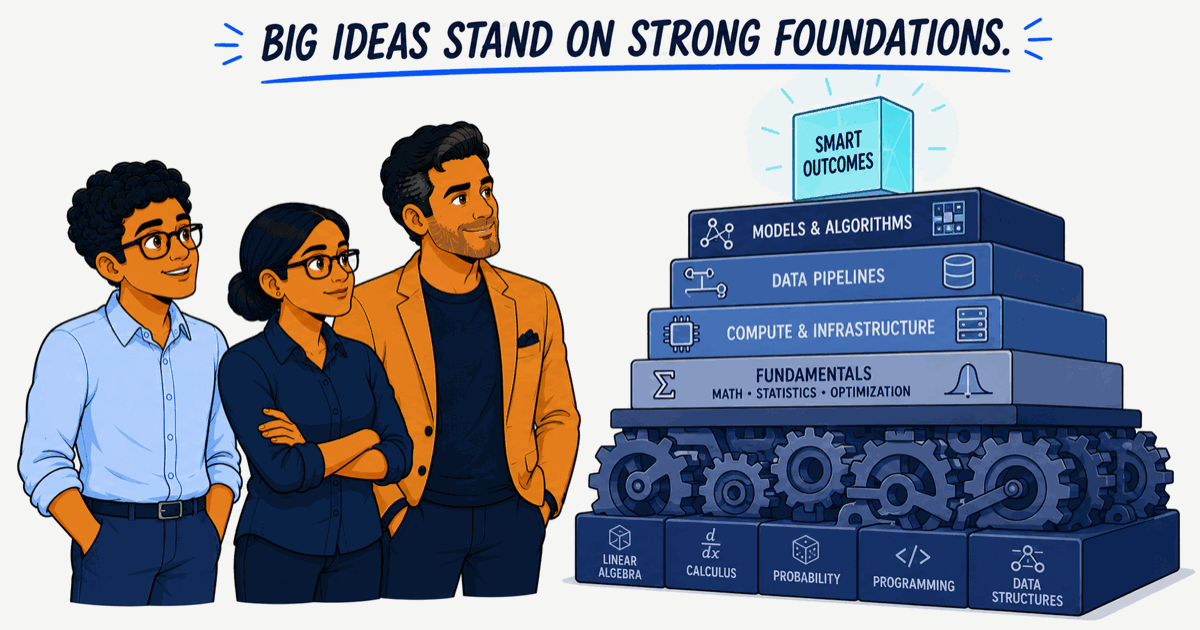
The demo always looks great. Two quiet layers under the model, your tooling and the basic maths, decide whether your AI results hold up or fall apart.
Key takeaways
- The model is rarely the thing that decides success. The plumbing and the basics underneath it usually are.
- A lot of real financial decisions still run on old, explainable models, not the newest AI.
- Almost every disappointing model fails in one of two opposite ways, and naming which one points straight at the fix.
Your AI runs on plumbing, and plumbing is a judgement call
Long before anyone trains a model, someone makes a pile of unglamorous choices. Which tools. Which versions. Which of the five near-identical options that all seem to do the same thing. It feels like setup, the boring part you rush through to get to the real work. It is not. It is where most of the time and money quietly leak out of AI projects.
The reason is that bad choices do not announce themselves. Pick the wrong combination and everything runs in the demo. Then, weeks later, two tools quietly disagree, a version mismatch surfaces, or a free cloud workspace wipes an afternoon of work overnight. Nothing breaks on day one. It breaks much later, when unpicking it is slow and expensive. It is the same reason a kitchen with a bad layout slows every single dish. Each part looks fine on its own. The friction lives in how they fit together.
In plain terms: the environment
The set of tools that install and run everything your model depends on, and keep one project from stepping on another. Several options overlap, so choosing is a judgement call. Knowing what quietly breaks when you choose wrong is the harder skill, and the one that separates a smooth project from a stalled one.
The same pattern repeats one level up, where teams pick the engine that trains the model itself. Two major options, PyTorch and TensorFlow, exist side by side because each wins in a different situation, not because one is simply better. Reaching for the bigger or more familiar name without asking what the task actually needs is how teams inherit months of avoidable friction. Their guides at pytorch.org and tensorflow.org exist precisely so the choice is informed rather than habitual.
The models running real decisions are older than you think
Here is something that surprises people. A lot of the AI making real financial decisions today is not the flashy kind. It is classical machine learning, methods that have been around for decades. When a bank scores your credit, flags a suspicious transaction, groups its customers, or forecasts demand, the model in the loop is often plain logistic regression or a decision tree, not a giant neural network. Those methods are fast, cheap to run, and, most importantly, explainable, so a human can see why a decision was made. Modern deep learning has not swept them away. It sits on top, adding power in the specific places it earns its keep. Knowing this is what lets a leader ask the sharp question, does this problem actually need a heavier model, or is someone reaching for horsepower it does not need. The everyday toolkit for these methods, the scikit-learn library, is still one of the most used in the field.
The one trade-off behind most models that disappoint
Almost every model that lets you down is failing in one of two ways, and they are opposites. Picture two new hires. The first learned three simple rules. He is steady and easy to trust, and he misses the nuance in anything complicated. The second memorised a thousand past cases in detail. She dazzles on anything close to what she has seen, then falls apart on a genuinely new situation. One is too simple. The other is too tuned to the past.
Models fail those exact two ways. Too simple and they miss the pattern. Too complex and they cling to the quirks of the data they trained on and wobble on anything new. The catch is that you cannot fix both at once. Make a model smarter about nuance and it gets less stable. Make it more stable and it gets blunter. The craft is finding the balance point where it gets the most right. That balance has a name, the bias-variance trade-off, and once you can see it, most model failures stop looking mysterious.
Slide from a simple model to a complex one and watch what happens to the result. If scripting is off, the table shows the same story.
| Model | Strength | Weakness | Result |
|---|---|---|---|
| Too simple | Steady and clear | Misses nuance | Underfits the problem |
| Balanced | Enough of both | Needs tuning | Gets the most right |
| Too complex | Captures detail | Unstable on new data | Overfits the past |
Why this matters even if you never touch the code
You do not need to build any of this to benefit from understanding it. The same trade-off between too simple and too tuned shows up in a basic model and in the largest AI system in the world. The plumbing that lets a team move fast does not choose wisely on its own, and the biggest model on the market does not either. Someone still has to decide what the problem actually needs. That judgement is the real job, and it does not come from the tool.
This is the quiet advantage in an age of loud AI. The leaders who get the most out of these systems are not the ones with the biggest model or the longest list of tools. They are the ones who understand what sits underneath well enough to ask better questions and to spot when something impressive is solving the wrong problem. Treat AI as an instrument, and keep the judgement with you.
Frequently asked questions
Do I need to understand the technical side to make good AI decisions?
You do not need to build models, but you do need to understand what sits under them. The basics, like the trade-off between a model that is too simple and one that is too tuned, decide whether the result holds up. Understand that and you can judge the work and ask sharper questions.
Why do so many AI projects look great in the demo and struggle later?
Because the weak point is usually the plumbing, not the model. A poor tooling choice runs fine on day one and breaks weeks later when versions clash or work is not saved. The failure is deferred, so it hides during the demo and surfaces in production.
Is old-fashioned machine learning still used in real systems?
Yes, and widely. Credit scoring, fraud detection, customer segmentation, and demand forecasting often run on classical methods like logistic regression and decision trees because they are fast and explainable. Deep learning adds to them where it helps rather than replacing them.
What is the bias-variance trade-off in plain terms?
It is the balance between a model that is too simple and one that is too complex. Too simple and it misses the pattern. Too complex and it clings to the quirks of its training data and wobbles on anything new. The goal is the balance point that gets the most right.