AI Without The Hype · 07 / 08
How AI Turns Pure Random Noise Into a Finished Picture
The AI behind modern image tools learned one humble skill, removing noise. Run it in reverse from pure static and a detailed picture emerges, step by step.
Key takeaways
- Diffusion models learn one humble skill, removing noise, then run it in reverse from pure static to build an image.
- They overtook the earlier forgery contest because training is stable, variety comes free, and quality is state of the art.
- A single dial, the number of steps, trades quality against cost, which is the practical lever that matters in production.
The whole idea, sculpting a picture out of static
Every diffusion model rests on one move that sounds too simple to work. During training, you take a real image and add a little random noise, then a little more, and keep going until the picture has dissolved into pure static, the grey snow of an untuned television. You do this only to create practice material. At each stage the model studies the noisy version and learns to estimate the noise that was added, so it can strip it back off. Repeat across millions of images and it becomes an expert at one thing, making a noisy image slightly cleaner.
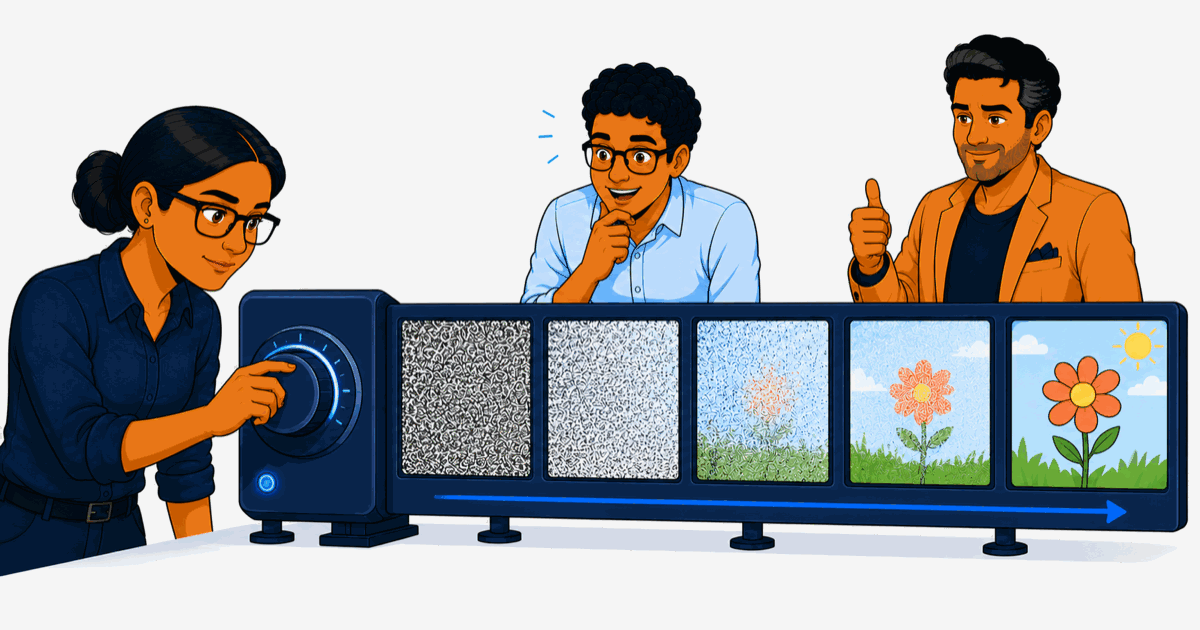
Now run that skill in reverse, and creation falls out of it. Begin with a fresh screen of pure static, static the model has never seen. Ask it to remove a little noise, and it nudges the mess a step toward looking like a real image. Feed that result back in and ask again. Step by step, structure emerges from the snow, the way a restorer lifts a painting out of layers of grime, until a clear, detailed picture stands where there was only noise. The model never sees a finished image while it works. It only ever makes what is in front of it a little less noisy, and that is enough.
In plain terms: diffusion
A way of generating images by learning to remove noise. The model practises by watching real images dissolve into static, learning to undo each bit of that damage. To create something new, it starts from pure static and reverses the process, cleaning the image a little at a time until a picture appears. The name comes from how an ordered image diffuses into disorder, then the model recovers order from the disorder.
Why this beat the forgery contest
The previous chapter described image generation as a contest between a forger and a detective, powerful but famously unstable, prone to producing the same few outputs and hard to keep balanced. Diffusion sidesteps all of that. There is only one network, trained on one clear goal, predict the noise accurately. No rivalry to referee, no delicate balance to hold. The training score falls smoothly and predictably, and because every image starts from a fresh patch of random static, variety comes for free rather than having to be coaxed out. That combination, stable training and reliable variety, is why since about 2022 diffusion has led on most measures of image quality and now sits behind the best-known image tools. The foundations were laid by Ho and colleagues in 2020.
The one dial that matters, steps against cost
The practical lever in a diffusion system is the number of denoising steps, and it is a direct trade between quality and cost. Ask a standard model for the image in a single step and you get a blurry, washed-out blob, because leaping from pure static to a finished picture in one go is hopelessly ambiguous. Give it around twenty steps and the image is clear and detailed. Push on to a hundred or a thousand and it barely improves, while the cost climbs in lockstep, since a hundred steps takes five times as long as twenty and a thousand takes fifty times. The useful discovery, formalised by Song and colleagues in 2020, is that roughly twenty well-chosen steps reach almost the same quality as a thousand. For anyone generating images at scale, that is the difference between a viable product and a ruinous compute bill.
Move the dial and watch quality and cost trade off. If scripting is off, the table below tells the same story.
| Steps | What you get | Cost |
|---|---|---|
| 1 step | A blurry colour blob | Cheapest, unusable |
| 5 steps | A rough shape emerges | Fast, low quality |
| 20 steps | Clear, detailed image | The sweet spot |
| 100 steps | Barely better than 20 | Five times slower |
How it follows your words, and why it fits on a laptop
Two more pieces turn this into the tools people actually use. The first is text control. To make the image match a prompt, the words are turned into a signal that is fed in at every denoising step, and the forming image pays attention to that signal, deciding which parts of the prompt matter where. That is the very same attention idea that powers language models, reused here to steer a picture. The second is efficiency. Running the whole process on full-resolution images is expensive, so systems like Stable Diffusion first compress the image into a much smaller stand-in, do all the denoising in that compact space, then expand the result back to full pixels at the end. That compression is exactly the navigable map from the chapter on early image generators, put to work so the model runs on an ordinary computer instead of a data centre. That same denoising painter is the piece the final chapter wires together with text and vision into the multimodal systems behind modern text-to-image tools.
Why this matters even if you never touch the code
For a leader, the mechanism matters less than four properties that shape how you use these tools. Quality is now good enough to replace stock photography for many purposes. The output is probabilistic, so the same prompt returns a different image each time, which is a feature for exploration and a hazard for anything that needs to be exact. Quality and cost pull against each other through the step count and the resolution, so someone has to choose the point that clears your bar without wrecking the budget. And the model mirrors the biases in the data it learned from, so outputs need a human eye before they carry your brand. In finance the earliest wins are practical, generating synthetic documents and forms to train fraud detectors, producing test data, and creating visual content for customers. The pattern from the whole of this series holds once more. The tool is remarkable, and the judgement about where and how to use it stays with you.
Frequently asked questions
How does a diffusion model create an image?
It learns one skill, removing a little noise from an image. To create, it starts from a screen of pure random static and removes noise a little at a time, step by step, until a clear picture emerges. It never sees a finished image while generating. It only knows how to make a noisy image slightly cleaner, and repeats that until nothing noisy is left.
Why did diffusion models overtake the earlier forgery-contest approach?
Because it trains one network on one simple goal, predict the noise, so training is stable and the score falls smoothly. There is no adversarial tug of war to balance and no collapse to a few looks. Variety comes for free because every run starts from fresh random static. Since about 2022 it has led on most image quality benchmarks.
Why does image generation take several steps instead of one?
Asking a model to jump from pure static to a finished image in one leap is too ambiguous, and you get a blurry colour blob. Removing noise a little at a time lets each step refine the last and steer toward something coherent. Around twenty well-chosen steps reaches nearly the same quality as a thousand, at a fraction of the cost.
How does a diffusion model follow a text prompt?
The words are turned into a signal that is fed in at every denoising step, and the image being formed pays attention to that signal, the same attention idea that powers language models. Systems like Stable Diffusion also work in a compressed version of the image rather than full pixels, which is what lets them run on an ordinary computer.
What should a business leader know about AI image generation?
Quality is now good enough to replace stock photography for many uses. The output is probabilistic, so the same prompt gives a different image each time. Quality and cost trade off through the number of steps and the resolution. And the model reflects the biases in its training data, so outputs need review before they represent your brand.